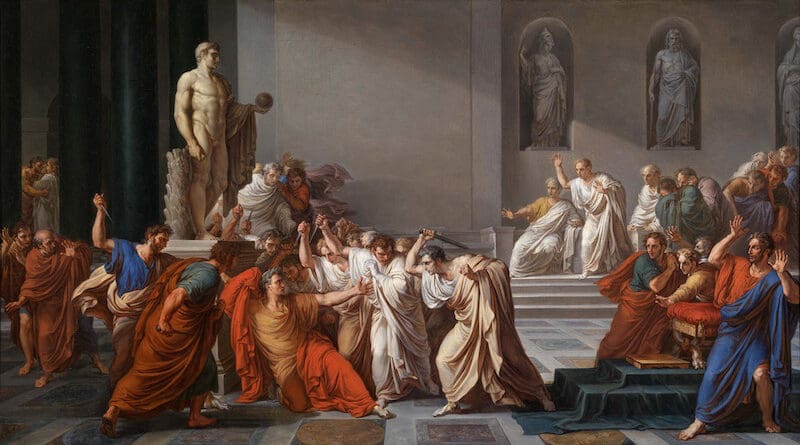
An Ancient Warning to the Modern World
Ancient Rome never fully disappeared from the political imagination.
Its law, architecture, republican vocabulary, military symbolism, and civic mythology survived the empire itself, resurfacing again and again in later European and American institutions. Few modern countries embraced that inheritance as visibly as the early United States. The connection is real. It is also more interesting than the familiar claim that America is simply “the new Rome.”
The founders lived in a political culture saturated with classical references. Roman republican history supplied stories about ambition, civic virtue, corruption, and the dangers of concentrated power. Figures such as Cincinnatus became moral shorthand for the citizen who accepts authority in a crisis and then relinquishes it.
George Washington was frequently compared with Cincinnatus for precisely that reason. The comparison mattered because the new republic was trying to establish a political norm that military victory did not entitle a leader to permanent rule. Classical influence also became visible in American civic imagery. The eagle had ancient associations long before the United States adopted its own version. Neoclassical architecture gave courthouses, capitols, banks, and monuments an aesthetic language associated with republican antiquity. The architecture was not merely decorative. It helped the young nation imagine itself as part of a much longer civic tradition. Roman influence on American government is more complicated.
The framers studied ancient republics, including Rome, but they did not simply copy the Roman constitution. Their system also reflected British constitutional experience, colonial government, Enlightenment political theory, state constitutions, and debates among the founders themselves. Rome offered both inspiration and warning.
Its mixed constitution, Senate, magistracies, and assemblies helped generations of political thinkers consider how power might be divided. But Rome also demonstrated how republican institutions could be weakened by inequality, faction, political violence, military power, and the erosion of norms.
American constitutional design attempted to address some of those problems through a different architecture of separated powers, federalism, elections, and an independent judiciary. Even here, the comparison has limits. Rome and the United States developed in radically different social, technological, economic, and legal worlds. Treating every modern political conflict as evidence of “Roman decline” can obscure more than it explains. The useful comparison is therefore not prophecy. It is perspective.
Rome reminds us that institutions do not operate independently of political culture. Written rules matter, but so do norms, incentives, public trust, and citizens’ willingness to accept legitimate limits on power. The founders understood that problem well. Their fascination with republican virtue reflected a belief that no constitutional mechanism could permanently compensate for a political culture that ceased to value self-government.
That idea remains worth considering even if we reject romanticized versions of both Rome and the American founding. America inherited Roman symbols and republican questions, not a predetermined Roman fate. The more productive question is not whether the United States is the new Roman Empire. It is which lessons from
Rome remain useful, which analogies mislead us, and what a modern republic must do that an ancient one could not.
0 Comments Add a Comment?