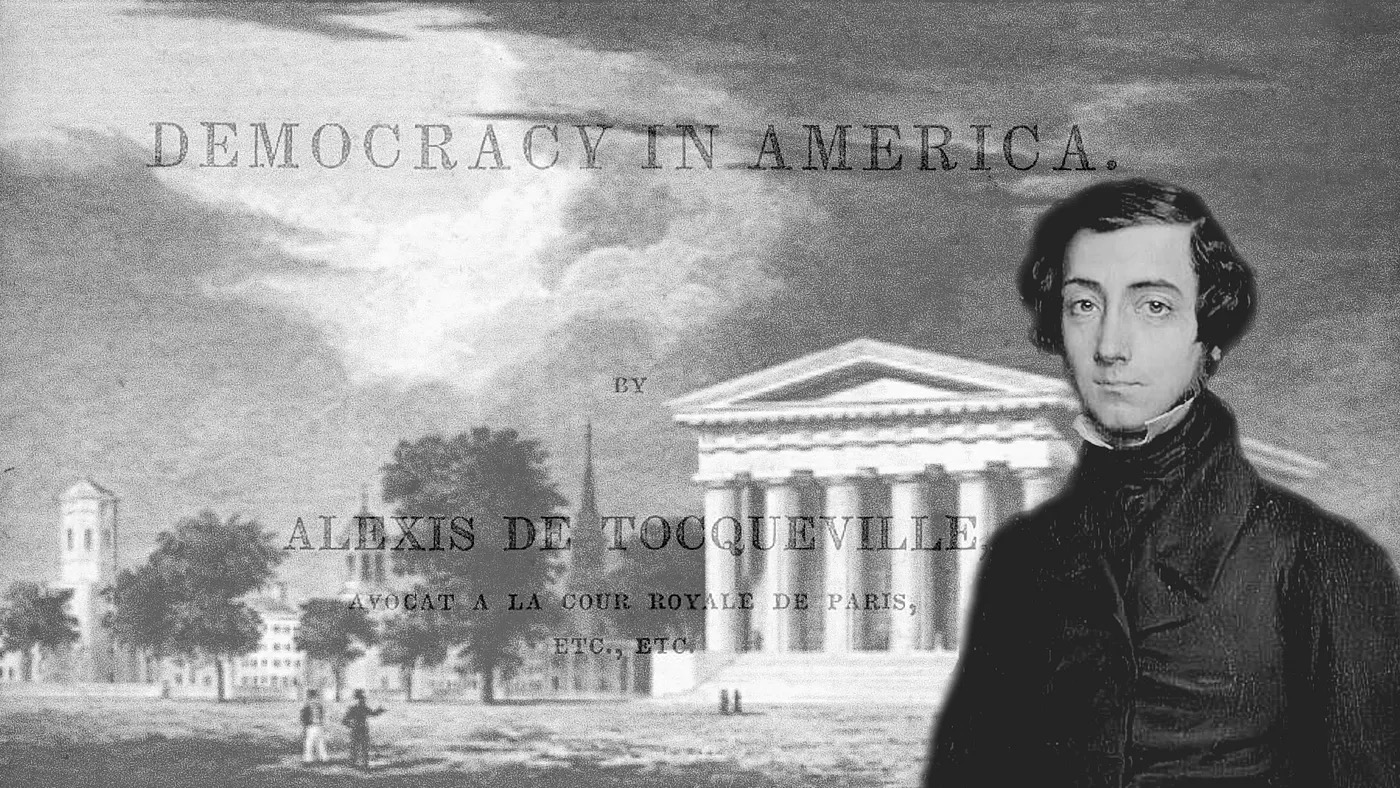
What Tocqueville Saw
In the early 19th century, French writer and political thinker Alexis de Tocqueville traveled to the United States to study its young democratic system. What he found fascinated him. Unlike European nations ruled by monarchs and aristocracies, America placed political power largely in the hands of ordinary citizens. Yet Tocqueville did not see American democracy as automatically stable or self-sustaining. In his book Democracy in America, he praised its strengths while warning of dangers that could eventually undermine it. Many of those warnings still feel relevant today.
Tocqueville believed American democracy was shaped by three major forces: the tension between **liberty and equality**, the rise of “individualism”, and the risk of a “tyranny of the majority”.
One of Tocqueville’s central concerns was the balance between liberty and equality. Americans strongly valued equality, especially equality of opportunity and political rights. Tocqueville admired this, but he worried that an excessive focus on equality could weaken freedom. When people care more about being equal than about being free, they may tolerate increased government control or social pressure if it promises uniform outcomes. In that situation, democracy can drift toward conformity, where independence of thought and personal freedom slowly erode. Tocqueville believed that liberty requires constant protection, even in societies that proudly call themselves democratic.
Another major theme in Tocqueville’s work is individualism. He observed that Americans were highly self-reliant and often skeptical of centralized authority. This independence encouraged people to form local groups, associations, and civic organizations, which strengthened democratic participation. Town meetings, volunteer groups, and civic engagement helped citizens learn how to govern themselves.
At the same time, Tocqueville warned that individualism had a darker side. When people become too focused on their private lives — their families, careers, and personal success — they may withdraw from public life altogether. Over time, this retreat weakens civic responsibility and leaves political power in the hands of fewer people. Democracy, Tocqueville believed, depends not just on voting, but on active participation and shared responsibility.
Tocqueville’s most serious warning concerned what he called the “tyranny of the majority.” In democratic systems, power is supposed to rest with the people, but Tocqueville feared that majority opinion could become so dominant that it silences minority voices. Unlike traditional tyranny, this form of oppression does not rely on violence or force. Instead, it operates through social pressure, public opinion, and political conformity. When everyone feels compelled to think the same way, genuine debate disappears, and democracy loses its moral foundation.
To guard against this danger, Tocqueville emphasized the importance of strong, balanced institutions. Independent courts, representative legislatures, and limits on executive power help prevent momentary popular passions from becoming permanent injustices. Democracy, in his view, requires restraints as much as it requires participation.
Finally, Tocqueville believed that democracy’s survival depended less on laws than on social habits and shared values — what he called “manners.” Respect for differing opinions, trust in institutions, and a willingness to compromise all helped sustain early American democracy. If those habits weaken, even the strongest legal system may fail to protect democratic ideals.
In the end, Tocqueville’s message was not pessimistic, but cautionary. American democracy, he believed, had great promise, but it was never guaranteed to last. Its survival depends on citizens who value freedom as much as equality, who remain engaged in public life, and who resist the temptation to silence those with whom they disagree. Nearly two centuries later, his insights remain a powerful reminder that democracy is not self-maintaining — it requires constant care, participation, and restraint.
0 Comments Add a Comment?