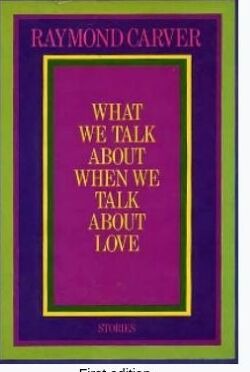
Book Review: What We Talk About When We Talk About Love
What We Talk About When We Talk About Love
Raymond Carver's stories put intimacy beside an open trapdoor. His couples drink, argue, and explain themselves in flat, ordinary language, and the danger collects in what nobody can quite say.
The title story shows the method at its best. Mel McGinnis, a cardiologist, pours gin for two couples and holds forth on love. He tells them about Terri's first husband, who beat her and dragged her across a room, and who she insists loved her anyway. Mel calls that not love at all. Then he tells of an elderly couple, badly hurt in a crash, swathed in bandages, with the husband despondent because he can't see his wife's face. Mel offers this as the real thing. No one settles the dispute. Mel wishes he could be a knight in armor, and the gin runs down as the afternoon light goes. The story never adjudicates: the same word covers a beating and a bandaged vigil, and the drinking loosens each speaker's certainty without improving it. By the end the bottle is empty and the room is dark, and the narrator hears nothing but the sound of the people in it.
The same charge runs through smaller pieces. In "Why Don't You Dance?" a man sets out his bedroom furniture on the front lawn, and a young couple wanders over to try the bed and the record player. Nothing is explained, not the man's drinking, not the wife who is gone. Months later the girl keeps trying to tell someone about it and can't find what the story was. That failure is the point. The omission has been handed on to the reader.
Here the collection's problem also shows. Lish's editing has complicated the image of Carver as an instinctive minimalist. D. T. Max documented the difficult author-editor relationship, and Giles Harvey argued that the severe published versions often surpass their longer originals. On the title story, I side with Harvey. The published ending stops in the dark and refuses the narrator, and us, any consolation. A fuller version, with more room for feeling, would be kinder. It would also be smaller. The cut is what keeps Mel's question hanging where he left it.
But the technique carries a real risk, and I don't think it is a minor one. When omission becomes the house style, it can turn into a recognizable literary effect, mess tidied into deadpan. Some stories here feel less like people withholding than like a writer performing withholding. The best pieces avoid this because their silences belong to particular people, such as Mel at his own table. Where the pattern outruns the people, the trapdoor becomes scenery.
Still, the collection endures. Carver's characters are neither exemplary victims nor convenient warnings. They are drinkers who find, over a bottle, that a shared vocabulary cannot guarantee a shared life.
Post a comment