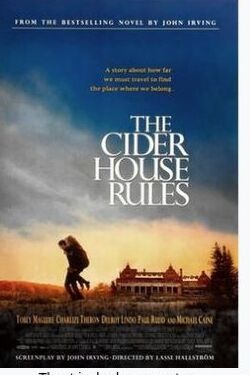
Book Review: The Cider House Rules
John Irving's The Cider House Rules is a novel about who writes the rules and who has to live under them. It sets that question in the orphanage at St. Cloud's, Maine, where Dr. Wilbur Larch delivers the babies of women who will not keep them and performs abortions for women who cannot. Larch is an ether addict, and every night he sends his orphans to sleep with "Good night, you Princes of Maine, you Kings of New England." Homer Wells, whom no family keeps, becomes his apprentice. He learns to deliver babies and refuses to end pregnancies, which is the first fissure in his upbringing.
The novel is best when it is most concrete about consequences. Larch practices in an era when the alternative to his work is a butcher's table, and Irving makes that vivid enough that his access argument needs no editorial. When Homer leaves for an apple orchard, he carries his refusal into a world that tests it. Wally's paralysis after the war is a coincidence that bears weight, because it forces Homer and Candy into a lie that costs everyone. The posted rules in the cider house, written by owners for workers who cannot read them, give the title its edge: authority is a set of instructions issued by people who will never live by them. The pivot comes when Rose Rose, pregnant by her father, stabs him, and Homer must decide whether principle still matters when she is the one who pays for it. That is the hardest question the book asks, and I think Irving answers it fairly: Homer's position is a serious one, but the novel ultimately sides with Larch.
The trouble is who gets to be complicated. Melony has the book's rawest energy, but her rage is finally a force that pursues Homer rather than a life of its own. Candy is mostly an object of two men's desire. Rose Rose is given the novel's most harrowing scene, and it is still the scene in which Homer's conscience changes. Mr. Rose and the Black crew are people the book notices, but the orchard's racial hierarchy mostly furnishes an occasion for the white hero's education. Irving's tenderness is real, but it is unevenly distributed, and the imaginative freedom belongs largely to Homer.
The machinery shows, too. Angel's parentage, Fuzzy Stone's stolen identity, and the way everyone converges on St. Cloud's are conveniences the Dickens comparison flatters rather than defends. Dickens's coincidences are load-bearing; Irving's are sometimes tidy. Robert M. Adams had a point when he objected to the strain of it.
Still, this is a big-hearted, argumentative novel that treats compassion as work, and its case for that work has not aged. It fails its female and Black characters more than its admirers admit, and that failure is worth naming. It is uneven in whom it lets be complicated, but it endures because it makes the cost of a rule visible, in Larch's secret work and in Homer's slow discovery that his refusal was never free.
Post a comment