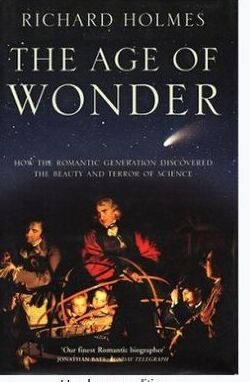
Book Review: The Age of Wonder
Editorial placeholder. Research-informed draft for D'Mitri Agnes to revise; not a statement of his personal assessment.
Richard Holmes
Richard Holmes brings Romantic science alive through discovery, ambition, and the unstable boundary between wonder and fear.
Review
Richard Holmes's The Age of Wonder restores uncertainty to discoveries that history has made look inevitable. Astronomy, chemistry, exploration, and ballooning unfold through people who do not yet know what their experiments will reveal. Science becomes a lived experience of excitement, rivalry, accident, and risk.
Holmes connects figures including Joseph Banks, William and Caroline Herschel, and Humphry Davy to the literary imagination of their period. The result challenges an easy division between scientific reason and Romantic feeling. Poets and experimenters inhabit overlapping worlds; a new account of nature can supply both knowledge and metaphor. Wonder is an impulse that sends people toward evidence, even when evidence unsettles the imagination that sought it.
Much of the book's favorable reception rests on Holmes's ability to make a large intellectual history feel personal and dramatic. The biographies give abstract changes a human scale. Caroline Herschel's presence also complicates the comfortable picture of discovery as the achievement of solitary great men. Observation depends on labor, collaboration, opportunity, and recognition, distributed unevenly.
The pleasure of this approach carries a risk. Charismatic lives and astonishing experiments can make progress seem more coherent than it was, while the institutions and imperial conditions surrounding discovery deserve scrutiny of their own. That is a question to bring to the book's narrative warmth, rather than a reason to reject it. Holmes is most valuable when his enthusiasm keeps the unknown alive. Scientific achievement becomes something people made under particular conditions, not a procession of facts waiting to be memorized. The book leaves readers with curiosity about the minds that asked the questions, and about what their answers could not settle.
A conversation for today
Debates about artificial intelligence and other emerging technologies often alternate between exhilaration and dread. Holmes offers historical perspective on that rhythm. The capacity to discover or build something does not, by itself, resolve how it should be used or who should benefit.
Post a comment