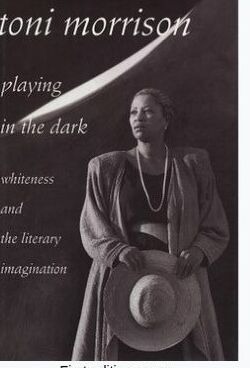
Book Review: Playing in the Dark
Toni Morrison's Playing in the Dark: Whiteness and the Literary Imagination began as lectures by a working novelist, and it reads like the notes of a writer who knows how the tricks are done. Instead of asking how American books represent Black people, Morrison asks what a Black presence allows white writers to do. She calls it the Africanist presence: the enslaved and darkly figured characters, images, and silences that white American writing uses to define freedom, innocence, and danger. What looks marginal to a story may be what holds it up.
Her reading of Poe's The Narrative of Arthur Gordon Pym shows the method at work. The novel's late episodes among the islanders of Tsalal, and its blinding white ending, are usually treated as Poe's private gothic. Morrison treats them as evidence. The white void the story ends in, she argues, depends on the darkness it has set up against it. Morrison links the first white image to “the expiration and erasure of the serviceable and serving black figure, Nu-Nu.” The shroud has meaning only because something had to be figured as its opposite. That argument makes a claim about how the book is built, not about Poe's character, and this is the book's real discipline. Morrison is not passing a moral judgment on dead writers. She is asking what a narrative needs in order to work, and finding that a "universal" American story often needed a figure it would not name.
Her limits are real. The book draws large conclusions from short passages, and it attributes a pattern to authors' choices that cannot be proved. It is also a short book, and shortness sometimes stands in for demonstration. William E. Cain questions how broadly Morrison characterizes earlier criticism as inattentive to race, and I think he has a point. She acknowledges Black writers and critics who saw these patterns before her, and the charge that the whole field was blind is too sweeping. But the overstatement is a flaw of proportion, not of insight, and the insight survives it. The book is best read as a method to be tested against each text, not a key that fits every lock.
That is what makes it useful in current fights over library collections and school curricula. Most of those arguments ask whether a book belongs. Morrison's method asks something prior: who decided what counts as a common American experience, and what did that definition require others to be? It makes her useful without making her a partisan. A reader who takes her seriously cannot treat "belonging" as a question only about the books currently challenged, because the long-unchallenged books have to answer it too.
I recommend it, with the qualification that its argument should be checked against the books it reads. It is less a verdict on the canon than a way of reading it, and once you have seen how a story leans on what it leaves unnamed, it is hard to read the same books as innocent again.
Post a comment